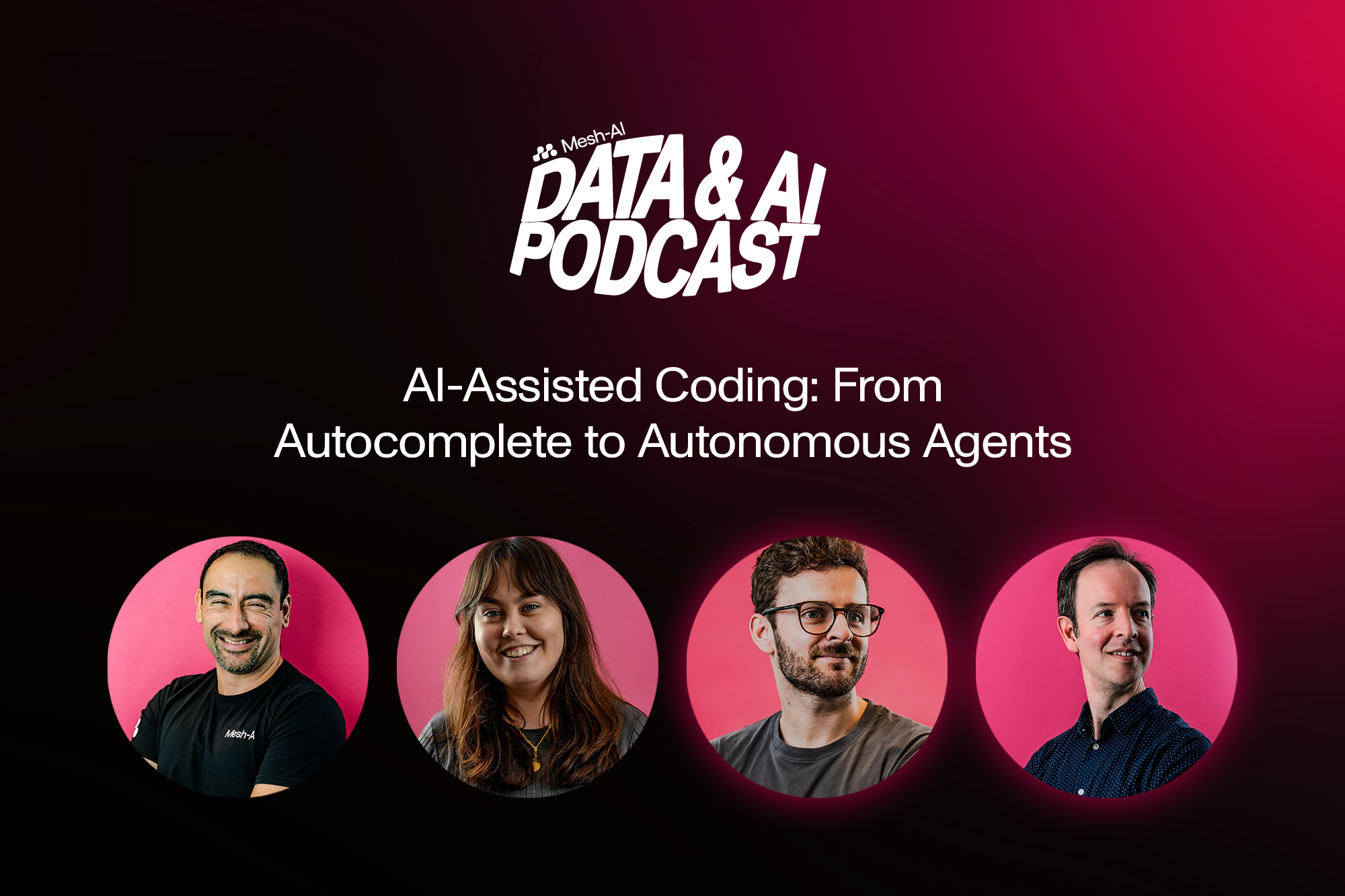
The landscape of software development is shifting beneath our feet. In the latest episode of the Data & AI Podcast, our engineering team sits down to discuss something that's affecting every developer today: AI-assisted coding tools and what they mean for the future of their profession.
Remember the early days of GitHub Copilot? The team discuss how it was essentially just like a better version of autocomplete and it didn't help at all as it would get things wrong. Fast forward to today, and we're looking at agentic coding systems that can edit, update, and generate substantial chunks of functional code.
But this journey wasn't just about raw capability - it was about trust.
As the team discusses, AI could write large chunks of code years ago. The real breakthrough came when developers could actually trust what these tools produced. It's a lot easier now to trust that what Claude or ChatGPT is outputting is something that will actually work and make sense to plug into a code base.
This trust didn't emerge from the AI alone. Improvements in user experience - particularly the ability to clearly see and compare changes -transformed these tools from frustrating autocomplete systems into genuine pair programming partners.
However, there are limitations, and the team identified several persistent challenges including:
Context Management: Tools still struggle to understand entire codebases and how different components interact. They might change source code when you ask for tests, or modify the wrong files entirely.
Forgetfulness: AI assistants have a tendency to drift from initial instructions, especially during longer coding sessions. While tools now offer ways to provide persistent guidelines (like Claude's code README files), this remains an ongoing challenge.
Hallucinations: Though less common now, AI tools can still suggest function calls or APIs that simply don't exist - a particular problem when working with less common libraries or frameworks.
One of the most thought-provoking ideas from the discussion is what the team playfully calls "guardrail engineering" - a potential future role focused on defining the boundaries and verification processes for AI-generated code.
Rather than replacing developers, the evolution seems to point toward a shift in responsibilities. For some solutions the developer will not be needed as a person who codes, but they will be needed as someone who verifies what is being coded.
This isn't a bleak outlook - it's a recognition that developer time is better spent on complex problem-solving and architectural decisions than on boilerplate code and routine implementations.
Perhaps the most important discussion centers on how AI coding tools affect skill development for early-career engineers. If junior developers rely too heavily on AI assistants, do they risk missing out on fundamental learning?
The team notes an interesting insight from previous research: the strongest engineers consistently score highest in fundamentals, not necessarily in specific technologies or breadth of knowledge. They explain that If you want to improve in any area of engineering, your best bet is to ensure that your fundamentals are good and then divert your attention to that specific area and you'll probably learn it faster.
This suggests that while AI tools might change how code is written, understanding what makes good software - architecture, design patterns, system thinking - remains critical.
The future likely includes autonomous agents building end-to-end systems for certain types of applications. But rather than eliminating the need for human developers, this evolution shifts the focus toward:
Verification and validation of AI-generated solutions
Behavior-driven development that defines expected functionality at a high level
Platform engineering that creates secure, performant frameworks for AI to work within
Best practices and guardrails that guide AI assistants toward quality outcome
The unanimous conclusion? Engineers aren't going anywhere. As one team member puts it, "Whether they like it or not, most coders, most engineers are using AI." The question isn't whether to adopt these tools, but how to use them effectively while maintaining quality, security, and the fundamental skills that make great engineers.
AI-assisted coding represents a shift in how we work, not the elimination of our work. And for those willing to adapt, the result is higher productivity, greater satisfaction, and more time spent on the challenging problems that drew us to engineering in the first place.
Listen to the full episode to hear the team's complete discussion, including their predictions for the next 5-10 years and advice for teams just starting to adopt AI coding tools.
The Data & AI Podcast explores the developments, insights and trends in data science and AI/ML. Our guests delve into the latest news and discuss the challenges on how enterprises are reimagining how they use data and AI to benefit their customers.
Interested in speaking on the show? Get in touch with us at podcasts@mesh-ai.com